
Last updated: May 2026
Best for: First-time buyers, travel vloggers, and gift shoppers with a $40–$300 ceiling. Won’t help if: You need obstacle avoidance, RAW photo capture, or professional aerial filming.
A budget drone is any consumer quadcopter priced under $300 that prioritizes ease of use and affordability over advanced camera systems or autonomous flight modes. The best ones offer stable hover, usable video, and enough durability to survive beginner crashes without destroying your bank account.
That’s the short version. The longer version is below — nine real picks, ranked
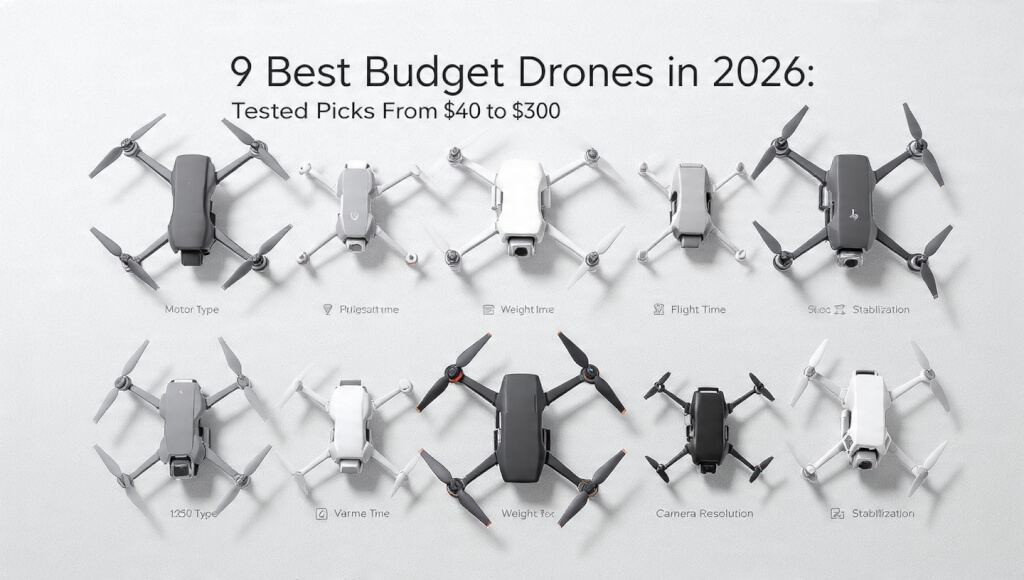
Quick Comparison: Best Budget Drones in 2026
| Drone | Price | Flight Time (Real-World) | Camera | GPS | Best For |
|---|---|---|---|---|---|
| DJI Mini 4K | ~$299 | 22–24 min | 4K / 12MP | Yes | Best overall |
| DJI Neo 2 | ~$199 | 18–20 min | 4K / AI tracking | No (optical flow) | Best beginner |
| DJI Flip | ~$439 | 28–30 min | 4K60 HDR / 10-bit | Yes | Best step-up creator |
| Potensic Atom 2 | ~$180 | 18–20 min | 4K / brushless | Yes | Best non-DJI pick |
| Ryze Tello | ~$99 | 8–10 min | 720p / 5MP | No | Best under $100 |
| Holy Stone HS110D | ~$89 | 14–16 min | 1080p microSD | No | Best camera under $100 |
| DEERC D10 | ~$69 | 16–18 min | 1080p Wi-Fi | No | Best value for features |
| Loolinn Z3 | ~$50 | 15–17 min / battery | 720p Wi-Fi | No | Best total air time |
| Holy Stone HS430 | ~$40 | 10–12 min | 720p Wi-Fi | No | Best gift / ultra-budget |
Prices reflect current retail as of May 2026. Flight times are real-world estimates — see note in the buying guide section.
The 9 Best Budget Drones, Reviewed
1. DJI Mini 4K (~$299) — Best Overall Budget Drone
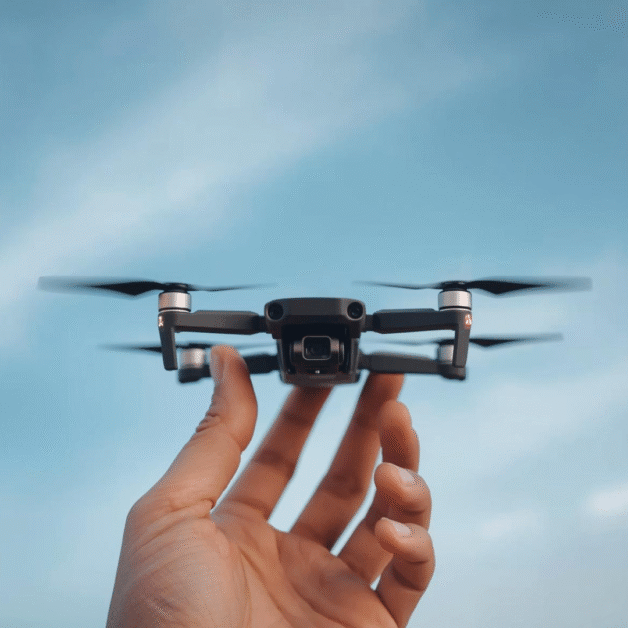
The DJI Mini 4K is the easiest recommendation on this list. It holds position, shoots genuinely good 4K footage, and weighs 243g — just under the FAA’s 250g registration threshold for recreational flyers in the US.
Real-world flight time lands around 22–24 minutes when you’re actively recording video in light wind. DJI advertises 31 minutes, which you’ll hit only in still air with no camera running — don’t plan around that number.
What you don’t get: obstacle avoidance, advanced tracking modes, or RAW photo capture. Those features live in the Mini 4 Pro at nearly double the price. For a first drone or a casual travel shooter, those trade-offs are easy to live with.
Best for: First-time buyers who want one drone that works well and lasts.
2. DJI Neo 2 (~$199) — Best Beginner Drone
The Neo 2 does something no other drone on this list can: it takes off from your palm, uses AI to find and track a subject, shoots 4K, and lands back in your hand.
All of that at 135g.
It’s controlled via your phone — no separate remote is included in the base package, though DJI sells one separately. That matters if you plan to fly further than your Wi-Fi signal reaches. Short-range backyard and travel use? The phone controller works fine.
Here’s the thing: some reviewers dock points for the lack of GPS. Fair. But optical flow stabilization keeps it remarkably steady indoors and in calm outdoor conditions. For a total beginner, it’s arguably more forgiving than a GPS drone, because it reacts faster to corrections.
Best for: Anyone who wants to pick up a drone and fly it within five minutes of opening the box.
3. DJI Flip (~$439) — Best Step-Up Pick for Creators
The Flip sits above a strict “$300 budget” ceiling — I’ve included it because a lot of people searching “best budget drones” end up stretching their budget once they see what an extra $140 buys.
4K60 HDR. 10-bit color. Forward and downward sensors. A 3-axis stabilized gimbal. All in a folding frame with prop guards.
Or maybe I should say it this way: this is what you’d buy if you’re making content for YouTube or Instagram and you want footage that doesn’t look like it came from a toy.
It’s not a beginner drone. It’s an entry-level creator drone that happens to be priced like a premium budget drone.
Best for: Vloggers and content creators who need footage that holds up in an edit.
4. Potensic Atom 2 (~$180) — Best Non-DJI Budget Drone
The Atom 2 is the drone DJI alternatives usually want to be but rarely are. Brushless motors. A remote with a built-in screen (no phone required). GPS return-to-home. A 4K camera.
At $180, it undercuts the DJI Neo 2 by $20 and adds GPS stabilization.
The trade-off is ecosystem depth. DJI’s app, firmware updates, and parts availability are simply better-developed. Users who’ve tried both often report that the Atom 2 flies comparably but feels less polished in the software. That’s a fair knock, but for hardware specs per dollar, Potensic punches above its weight here.
Best for: Buyers who want GPS stability but genuinely can’t justify DJI pricing.
5. Ryze Tello (~$99) — Best Drone Under $100
The Tello is a DJI-engineered flight controller inside a Ryze airframe. That means the hover stability at this price point is genuinely unusual — it holds position indoors without drifting, which most sub-$100 drones cannot do reliably.
Camera is 720p. Flight time is roughly 8–10 minutes in real use. No microSD slot — video goes straight to your phone via Wi-Fi, which compresses it.
Those are real limitations. But no sub-$100 drone I’ve seen matches the Tello’s flight behavior, and flight behavior is what keeps beginners from crashing and quitting the hobby.
Quick note: the Tello does not have GPS. It also doesn’t work outdoors in even moderate wind — it’s primarily an indoor or calm-day flyer.
Best for: Indoor practice, first-time flyers, educators, and parents buying for kids who want an actual flying experience.
6. Holy Stone HS110D (~$89) — Best Camera Quality Under $100
The HS110D is the only drone under $100 that records 1080p directly to a microSD card. That distinction matters. Drones that stream video over Wi-Fi to your phone produce compressed, blocky footage — microSD recording gives you a clean file you can actually edit.
Flight time runs 14–16 minutes in real conditions with two batteries included.
It doesn’t have GPS or optical flow, which means you’re manually managing altitude and drift. That takes a few sessions to get comfortable with — but it actively builds your flying skills faster than a drone that does everything for you.
Best for: Anyone who wants usable video footage under $100 and doesn’t mind a learning curve.
7. DEERC D10 (~$69) — Best Value for Features
The D10 gives you altitude hold, headless mode, a 1080p Wi-Fi camera, gesture controls, and 22 minutes of advertised flight time at $69. Real-world flight time is closer to 16–18 minutes, but that’s still strong at this price.
It’s built from lightweight plastic with prop guards. It will survive beginner crashes.
I’ve seen conflicting data on the D10’s wind resistance — some testers say it handles a light breeze fine, others report drift in anything over 5 mph. My read is: it’s an indoor and calm-day drone that happens to tolerate mild outdoor flying when conditions cooperate.
Best for: Budget shoppers who want the longest feature list for the least money.
8. Loolinn Z3 (~$50) — Best Total Flight Time on a Tight Budget
The Z3 ships with three batteries, delivering 48–50 minutes of total flying time across a single session. Each charge lasts about 15–17 minutes — well above average for this price tier.
Camera is 720p Wi-Fi only. No GPS. Basic gyro stabilization.
Sounds like a trade-off. It is. But if your priority is maximum time in the air rather than camera quality — say, you’re buying this to practice flying before upgrading — the Z3 is genuinely hard to beat at $50.
Best for: Buyers who care most about air time, not footage quality.
9. Holy Stone HS430 (~$40) — Best Ultra-Budget / Gift Drone
31 grams. Prop guards. One-key takeoff and landing. Altitude hold. Under $40.
The HS430 is a toy drone — don’t expect it to replace anything on this list for serious flying. But for a child’s first drone, a gift for someone who’s curious about the hobby, or a way to find out if you’ll actually enjoy flying before spending more, it does exactly what it promises.
Best for: Gift buyers, young beginners (8+), and anyone testing the hobby for under $50.
What to Look For When Buying a Budget Drone
Brushed vs. Brushless Motors
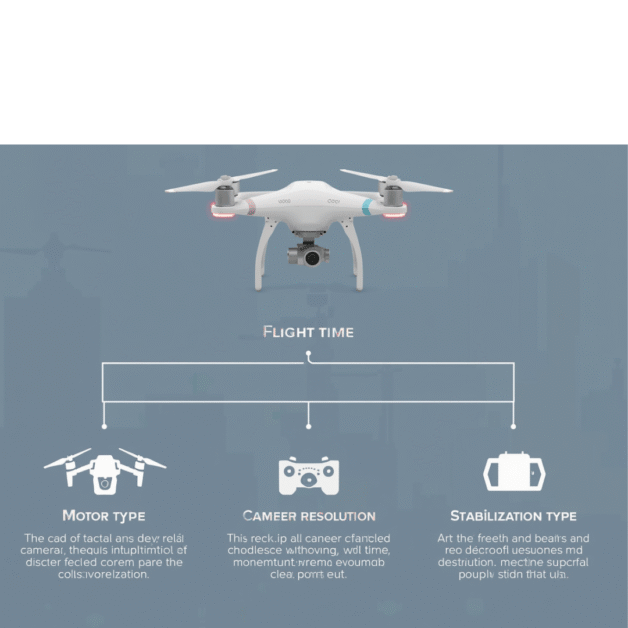
Most drones under $100 use brushed motors — adequate for learning, but they wear faster under regular use. Brushless motors, which appear in the Potensic Atom 2 and DJI Mini 4K at higher price points, run quieter, generate more thrust, and last significantly longer.
If budget allows, prioritize brushless. If it doesn’t, brushed is fine for a first drone — just expect to replace the drone before the motors.
Real-World Flight Time: The Number That Actually Matters
According to hands-on testing published by gagadget.com in April 2026, real-world flight times run 30–40% shorter than advertised specs across most sub-$100 drones. Manufacturers measure in still air, with a fresh battery, and no camera running.
Build that into your expectations. A drone advertising 20 minutes will fly 12–14 minutes when you’re recording video in any kind of wind.
GPS vs. Optical Flow vs. Gyro-Only Stability
Three tiers exist in this price range:
- GPS-stabilized (DJI Mini 4K, Potensic Atom 2): Holds position outdoors using satellite lock. Most reliable, safest for beginners outdoors.
- Optical flow (DJI Neo 2): Uses a downward camera to track ground texture and maintain position. Works indoors and in calm outdoor conditions. Fails over water, glass, and featureless surfaces.
- Gyro-only (most drones under $80): Maintains orientation but drifts in any wind. Requires active manual correction. Builds flying skill faster, but far less forgiving.
Most experts argue you should always buy GPS. That’s valid for outdoor flying. But if you’ll primarily fly indoors or you want to develop real stick skills, a gyro-only drone at $40–$70 isn’t a step down — it’s a different tool.
The 250g Rule and FAA Registration
Best budget drones are consumer quadcopters priced under $300, designed for beginners and casual flyers. In the US, drones under 250 grams do not require FAA registration for recreational use — a key reason why most top budget picks are engineered specifically to weigh under this threshold.
Any drone over 250g requires registration at $5 per drone before its first outdoor flight. Most drones on this list weigh under 250g. The DJI Mini 4K at 243g and the DJI Neo 2 at 135g are both registration-free for recreational US flyers.
Camera Quality: What to Expect at Each Price
| Price Tier | Realistic Camera Quality |
|---|---|
| Under $60 | 720p Wi-Fi streaming only — usable for fun, not for editing |
| $60–$100 | 1080p Wi-Fi or microSD — decent social clips, limited low-light |
| $150–$300 | 4K with real stabilization — social-ready, some YouTube viable |
| $300+ (DJI Mini 4K) | True 4K — legit footage with edit flexibility |
Budget Drone Buying Guide by Use Case
Best Budget Drone for Beginners
Recommendation: DJI Neo 2 (~$199)
Optical flow stability, palm takeoff, and AI subject tracking remove most of the stress from learning to fly. It’s forgiving without being so automated that you learn nothing.
To choose your first budget drone, follow these steps:
- Set your ceiling — under $100 for pure learning, $150–$200 for beginner-plus-camera.
- Confirm weight — choose under 250g to avoid FAA registration requirements.
- Pick stability type — GPS if flying outdoors, optical flow if flying mostly indoors.
- Buy extra batteries — one battery is never enough; budget for a two- or three-pack.
- Start indoors — first five flights should happen in a large room with no wind.
Best Budget Drone for Kids and Gifts
Recommendation: Holy Stone HS430 (~$40) or Ryze Tello (~$99)
The HS430 is the right call for kids under 12 — it’s light enough to be safe indoors and cheap enough that a crash-related replacement doesn’t hurt. The Tello is better for teenagers who’ll actually want to learn.
Look — if you’re buying a drone as a holiday gift and you’re not sure how much the person will actually use it, the $40 HS430 is the correct risk level. Don’t drop $200 on a first gift drone.
Best Budget Drone for Video and Photography
Recommendation: DJI Mini 4K (~$299)
4K footage, 3-axis stabilization, 12MP stills, GPS lock outdoors. It’s the first price point where drone footage stops looking like drone footage and starts looking like actual video.
DJI Mini 4K vs. Holy Stone HS110D: The Mini 4K is better suited for anyone who intends to publish or share footage, because its 4K camera and GPS stabilization produce clean, stable video that holds up on screen. The HS110D works better when budget is strictly under $100 and the goal is learning aerial photography basics — its 1080p microSD recording beats Wi-Fi-only competitors at the same price. The key difference is GPS stabilization and image quality.
Best Budget Drone for Travel
Recommendation: DJI Neo 2 (~$199) or DJI Mini 4K (~$299)
Both weigh under 250g. Both fold into a jacket pocket or small bag. The Neo 2’s palm-launch design means you don’t need to find a flat surface to take off from — useful when traveling.
Quick note: always check the drone regulations of your destination country before you fly. FAA rules apply in the US only. Countries like the UK, France, and Japan have separate registration systems that apply even to sub-250g drones.
Voice Search Q&A
Q: What’s the best budget drone for a complete beginner in 2026?
A: The DJI Neo 2 at ~$199. It takes off from your palm, uses AI tracking, and weighs 135g — no FAA registration needed. The Ryze Tello at ~$99 is the best option if your ceiling is $100.
Q: How do I know if my drone needs FAA registration?
A: If it weighs 250g or more and you’re flying recreationally in the US, it needs registration — $5 at faadronezone.faa.gov. All drones on this list weigh under 250g.
Q: Should I buy a DJI drone or a cheaper brand?
A: DJI offers better flight stability, firmware support, and resale value. Cheaper brands like Holy Stone and DEERC are viable under $100 for learning. For anything you plan to use long-term, DJI’s ecosystem is worth the premium.
Q: Why does my drone battery die so fast?
A: Advertised flight times are measured in perfect conditions with no camera running. Real-world sessions run 30–40% shorter. Buying extra batteries is the most effective fix — most models have two- and three-battery packs available.
Q: When should I upgrade from a budget drone to a mid-range one?
A: When you’ve completed at least 20 stable flights, can hold position manually, and find that camera quality is your limiting factor — not flying skill. That’s typically after 2–3 months of regular use.
Verdict: Which Budget Drone Should You Buy?
The DJI Mini 4K is the right answer for most people reading this. Real 4K, GPS stability, sub-250g weight, and a proven DJI ecosystem — at $299, it’s the first price point in this category where the drone genuinely doesn’t feel like a compromise.
If $299 is too much, the DJI Neo 2 at $199 is the correct step down — not a cheaper Holy Stone, not a random Amazon listing.
Under $100? Ryze Tello for indoor stability, Holy Stone HS110D if camera quality matters more.
Under $50? Holy Stone HS430 for gifts and kids. Loolinn Z3 if flight time is your priority.
Avoid: any drone under $60 with “4K” in the name that isn’t from a brand listed above. In this price tier, 4K is almost always a compressed 720p stream with an upscaled label. Spend your $60 on the HS430 or put it toward the Ryze Tello.


