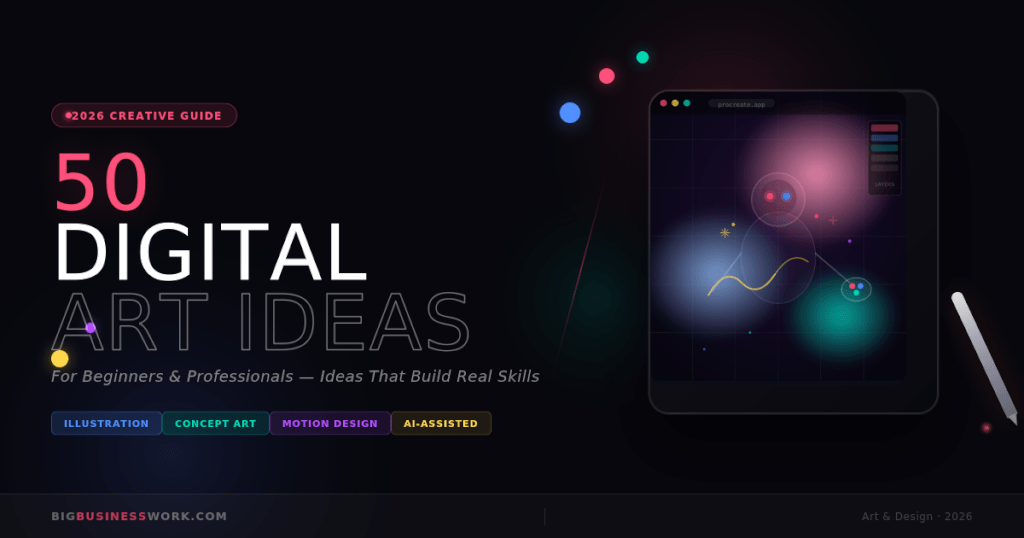
50 Digital Art Ideas That Will Actually Make You a Better Artist in 2026
What separates artists who grow from those who stagnate isn’t talent — it’s the habit of trying new things. Whether you’ve just picked up a stylus for the first time or you’ve been painting digitally for years, the right idea at the right moment can completely unlock your creative potential. In 2026, digital art isn’t just a skill — it’s a full creative ecosystem blending hand-drawn instincts, AI-assisted workflows, motion, and narrative. The field has never been broader, and the entry point has never been lower.
So if you’re searching for digital art ideas to break through your next art block, push your portfolio, or simply have fun on a Friday night — you’ve landed in the right place.
50 Digital Art Ideas to Spark Your Creativity and Grow Your Skills
Before diving into the list, it helps to understand one thing: the best digital art ideas aren’t just prompts. They’re vehicles for building real technique. Each idea below is paired with a skill focus — a reason why doing it will make you a better artist, not just a busier one.
Beginner-Friendly Ideas (1–20)
These are structured to build foundational skills. Don’t let “beginner” fool you — several professionals return to these deliberately.
1. Sunset Over Still Water Paint a simple landscape focusing only on gradients and color blending. Skies and water both demand smooth transitions, making this one of the best exercises for understanding light and value.
2. A Single Lit Candle Small, isolated subjects are deceptively challenging. Painting a candle teaches you to handle warm light against cool shadows — a core skill in digital painting.
3. Your Own Hand Hands are notoriously tricky. Sketching your own hand from observation builds observational accuracy faster than almost any other exercise.
4. A Simple Mug or Cup Still life objects train your eye for perspective, cylindrical form, and reflective surfaces. A ceramic mug is perfect for experimenting with highlights.
5. Flat Icon Pack (10 Icons) Design a set of 10 cohesive flat icons in a single color palette. This introduces you to vector thinking, consistency, and visual hierarchy.
6. Cartoon Self-Portrait Stylize your own face into a cartoon avatar. It teaches simplification — reducing complex features into clean, readable shapes.
7. A Slice of Cake Soft textures, layered colors, and tempting shapes. Food illustration has a massive online audience and is a genuinely enjoyable way to explore color and form simultaneously.
8. Your Favorite Animal in a Flat Style Choose one animal and render it flat. Research color palettes, define your shapes, and learn to work without gradients.
9. Cloud Study Paint three different cloud types (cumulus, stratus, cirrus) across a single canvas. Clouds are forgiving but teach atmospheric depth.
10. A Rainy Window Scene Water droplets on glass, blurred street lights behind — this scene trains you in texture, layer blending modes, and mood.
11. Simple Character Pose (Standing) Design a character in a neutral standing pose. Focus on silhouette readability — can someone recognize the character from the shadow alone?
12. Monochromatic Forest Create a forest scene using only one hue in varying shades and tints. Removing color forces you to master value contrast.
13. Glowing Neon Sign Design a retro neon sign on a dark background. Bloom and glow effects are beginner-friendly and immediately visually satisfying.
14. Pixel Art Character Sprite Create a tiny character sprite (32×32 or 64×64 pixels). Pixel art teaches economy of detail — every pixel has a job.
15. Watercolor-Style Botanical Print Using brushes that simulate watercolor, paint a flower or leaf with loose, organic strokes. Illustrators are increasingly incorporating brushes that simulate graphite, charcoal, ink, and watercolor to achieve a handmade finish without giving up digital flexibility.
16. A Starry Night Sky Paint a night sky emphasizing depth through star scale variation and a subtle gradient from deep navy to near-black.
17. Chibi-Style Character Draw a chibi (cute, simplified) version of any character. Large heads and exaggerated expressions are excellent for learning emotional expression in design.
18. Minimalist Movie Poster Pick a favorite film and redesign its poster using only geometric shapes and two colors. This is a masterclass in communicating story through abstraction.
19. Cartoon Pet Portrait Take a photo of any pet (yours or from a reference site) and recreate it in a cartoon style. This combines observation with stylization.
20. A Simple Map Design a hand-drawn-style fantasy map with small landmarks, rivers, and forests. This is fantastic for developing your illustration confidence without pressure.
Intermediate Ideas (21–35)
At this level, the focus shifts from completing work to developing a point of view.
21. Surreal Portrait with Nature Elements Combine elements of fine art and surrealism to create digital portraits that challenge reality — merging natural elements with human features to explore themes of nature and identity.
22. Retro Futurist Cityscape Retro Futurism blends vintage aesthetics with futuristic ideas — rockets, chrome surfaces, analog screens, and grids — resulting in images that feel nostalgic and speculative at the same time. Build a city that looks like a 1960s prediction of 2100.
23. Surreal Minimalist Composition Surreal minimalism uses simple compositions, clean layouts, and limited elements. Rather than telling a full story, it suggests ideas or emotions and leaves room for interpretation. Create one such piece using just three objects that don’t logically belong together.
24. Botanical Abstract Piece Botanical-inspired art in 2026 explores themes of peace, calmness, and connection with nature — often blending abstraction, surrealism, and portraiture, with flowers and plants used as metaphors for growth, intimacy, or vulnerability.
25. Editorial Digital Collage Digital collage in 2026 takes a more editorial and conceptual approach — combining photographic cutouts, expressive typography, scanned textures, digital brushstrokes, and hand-drawn elements into a hybrid aesthetic ideal for cultural projects, posters, or covers.
26. “A Day in the Life” Concept Art Series Develop a series of digital artworks around a conceptual theme — such as a day in the life of different professionals — experimenting with different formats and styles like watercolor or 3D modeling.
27. Limited Palette Landscape Restrict yourself to exactly four colors and paint a full environment. Constraint-based art builds stronger compositional instincts than unlimited palettes.
28. Character Design Sheet Design a character with a front view, side view, and three facial expressions on a single sheet. This is standard industry practice in game and animation workflows.
29. Urban Sketch Transformation Take a photograph of any street and repaint it digitally, but change the time of day, weather, or era. This develops “translation” skills — seeing what a scene could be.
30. Fantasy Creature Design Combine two unrelated animals into one original creature. Focus on making it anatomically believable. This is a core concept art skill.
31. Analog Texture Hybrid Scan a physical texture — rough paper, a painted swatch, fabric — and incorporate it as a layer in your digital work. It is increasingly common to digitize real textures like rough paper and watercolor stains to integrate them in layers and enrich the composition, adding depth, imperfection, and humanity.
32. Typography Poster Choose a quote and build an entire poster where the type arrangement is the visual. No illustrations — just letterforms, weight, and space.
33. Emotional Color Study Paint the same simple scene (a room with a chair and window) four times — once for joy, grief, anxiety, and calm. Change only the palette and lighting.
34. Isometric Room Design Design a cozy isometric room from above at a 45-degree angle. Isometric illustration is in high demand for app design and editorial work.
35. Micro-Animation Loop Micro-animations are subtle motion additions to still illustrations — eyes blinking, smoke drifting, cloth blowing naturally. These tiny loops draw readers in and bring covers or pages to life. Tools like Procreate Dreams and After Effects make this accessible at the intermediate level.
Advanced and Pro-Level Ideas (36–50)
These ideas demand technical range, conceptual depth, and intentional style.
36. AI-Assisted Concept Art In 2026, AI is consolidating as an ally rather than a substitute — illustrators use it to sketch quick ideas, explore style variations, generate color palettes, and create visual references for complex pieces. Tools like Firefly and Midjourney integrated with Photoshop become a natural part of the process. Use AI to generate five reference variations, then hand-paint the final piece entirely yourself.
37. 3D and 2D Hybrid Illustration Artists are mixing 3D elements with 2D illustration, adding subtle depth, turning static compositions into moving ones — even a minimal piece feels richer when something moves or breathes within it.
38. Personal Mythology Series Create a 5-piece series based on a mythology or visual world entirely of your own invention. Every piece should feel like it belongs to the same visual universe.
39. Game Concept Art Pitch Design all assets for an imaginary video game: a hero, a villain, two environments, and a UI element mockup. This is portfolio-level work that opens doors in the games industry.
40. Motion Graphic Explainer Loop Build a 10-15 second looping animation that explains one concept visually — no words. Pure visual communication is one of the hardest and most valuable skills in digital media.
41. Glitch Art Portrait Deliberately distort a digital portrait using data-bending, pixel sorting, or scan-line effects. Glitch art turns technical errors into expressive tools.
42. Procedural / Generative Art Piece Write or customize code (using tools like Processing or p5.js) to generate a visual pattern from rules rather than manual drawing. Generative art is a growing field that merges programming with visual design.
43. Illustrated Children’s Book Page Design a single spread from an imaginary children’s book. This demands clarity, warmth, and the ability to tell a story in one image — skills transferable across nearly every illustration context.
44. Brand Identity System Design a complete visual identity for a fictional brand: logo, color palette, typography, one mock packaging item, and one social media post. Thinking in systems — designing with flexibility so the style applies to logos, websites, social media content, and merchandise — is one of the key approaches shaping commercial digital art in 2026.
45. Hyper-Detailed Environment Paint a full environment so richly detailed that it tells a story without a single character present. Think lived-in spaces — a cluttered workshop, an abandoned station, a street market at dusk.
46. Interactive AR Sketch Procreate’s built-in AR view and tools like Autodesk Fusion allow artists to branch out from 2D painting into immersive formats without requiring new hardware. Design a piece intended to be experienced in augmented reality.
47. Zine or Editorial Layout Design Design the full layout for a six-page digital zine on any topic you care about. Editorial design is illustration plus information architecture — a rare and powerful combination.
48. Album Cover Redesign Take a classic album and redesign its cover using a completely different visual language — same emotional energy, entirely new aesthetics.
49. Illustrated Data Visualization Take a real dataset (population stats, climate data, historical timelines) and turn the numbers into a beautiful hand-crafted infographic. This bridges art and information design.
50. Your Artistic Manifesto Piece Create one piece that defines your current artistic identity. What do you believe about art? What makes your work yours? Put that into a single image. According to artists and design researchers, the most resonant work in 2026 is deeply personal — work that feels connected to real people resonates more than technically impressive but emotionally empty pieces.
How to Get the Most Out of These Digital Art Ideas
Having 50 ideas is only useful if you actually start. A few principles that separate artists who grow quickly from those who circle the same comfort zone:
Choose ideas slightly above your comfort level. The goal isn’t to make a perfect piece — it’s to encounter a new problem and solve it. Difficulty is the point.
Finish everything. Abandoned work teaches you nothing about resolution, cropping, final presentation, or how a piece actually lands when someone else sees it.
Keep a process file. Save your layers and working files. Six months from now, watching your own process will tell you more about your growth than any tutorial.
Mix mediums intentionally. Combining AI with analog texture, collage with motion, or limited palettes with scanned materials often produces the most surprising results. The combinations that feel strange in theory tend to be the most original in practice.
The Bigger Picture: Why Digital Art Ideas Matter More Than Ever in 2026
In 2026, the dominant shift in digital art isn’t a single style or aesthetic — it’s a blending of tech, craft, humanity, and storytelling. The artists who are standing out aren’t those chasing trends, but those using trends as raw material to say something specific and personal.
Whether you are working through idea number three on this list or pushing toward the final ten, what you are really building is a creative practice — a habit of showing up, experimenting, and finishing. That practice, more than any tool or technique, is what separates the artists people remember from the ones who stay perpetually “about to start.”
Pick one idea. Open your software. Begin.